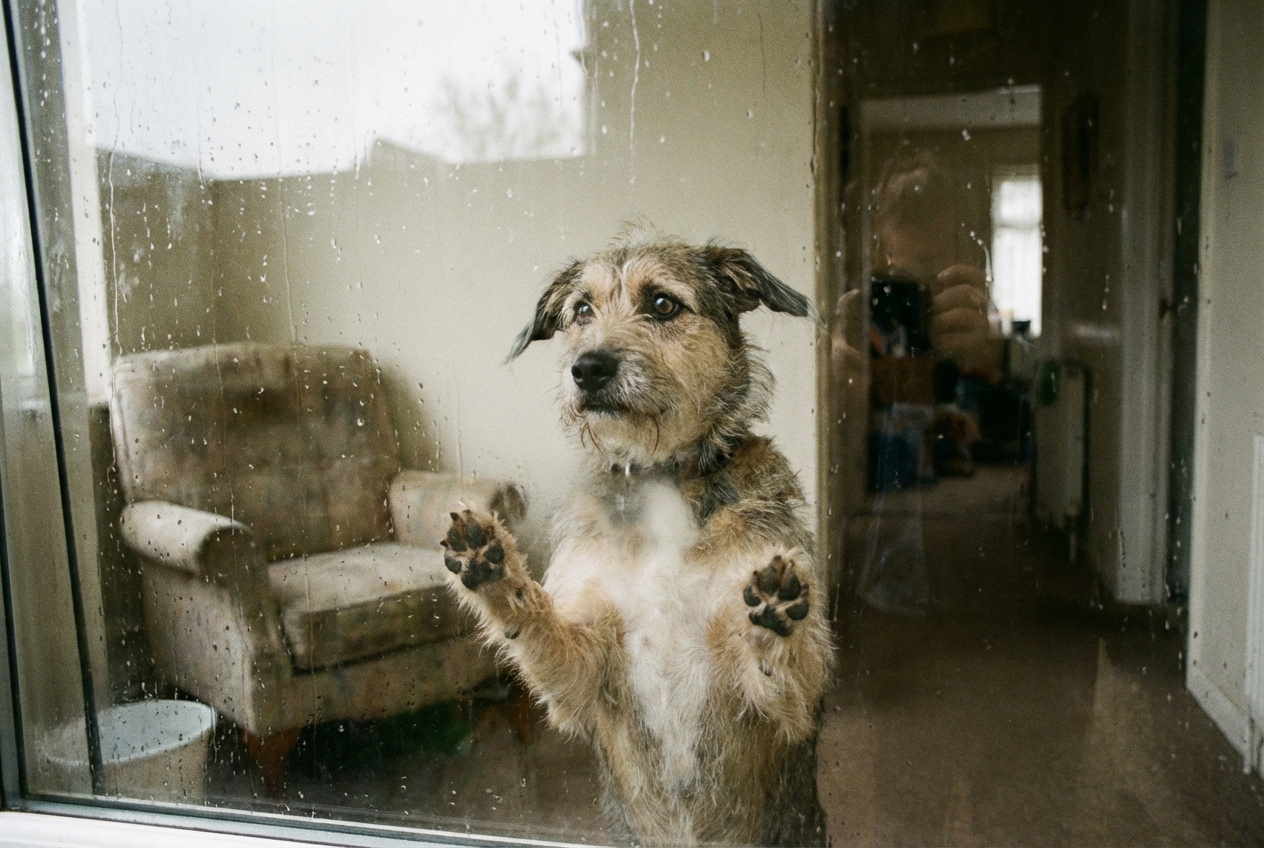
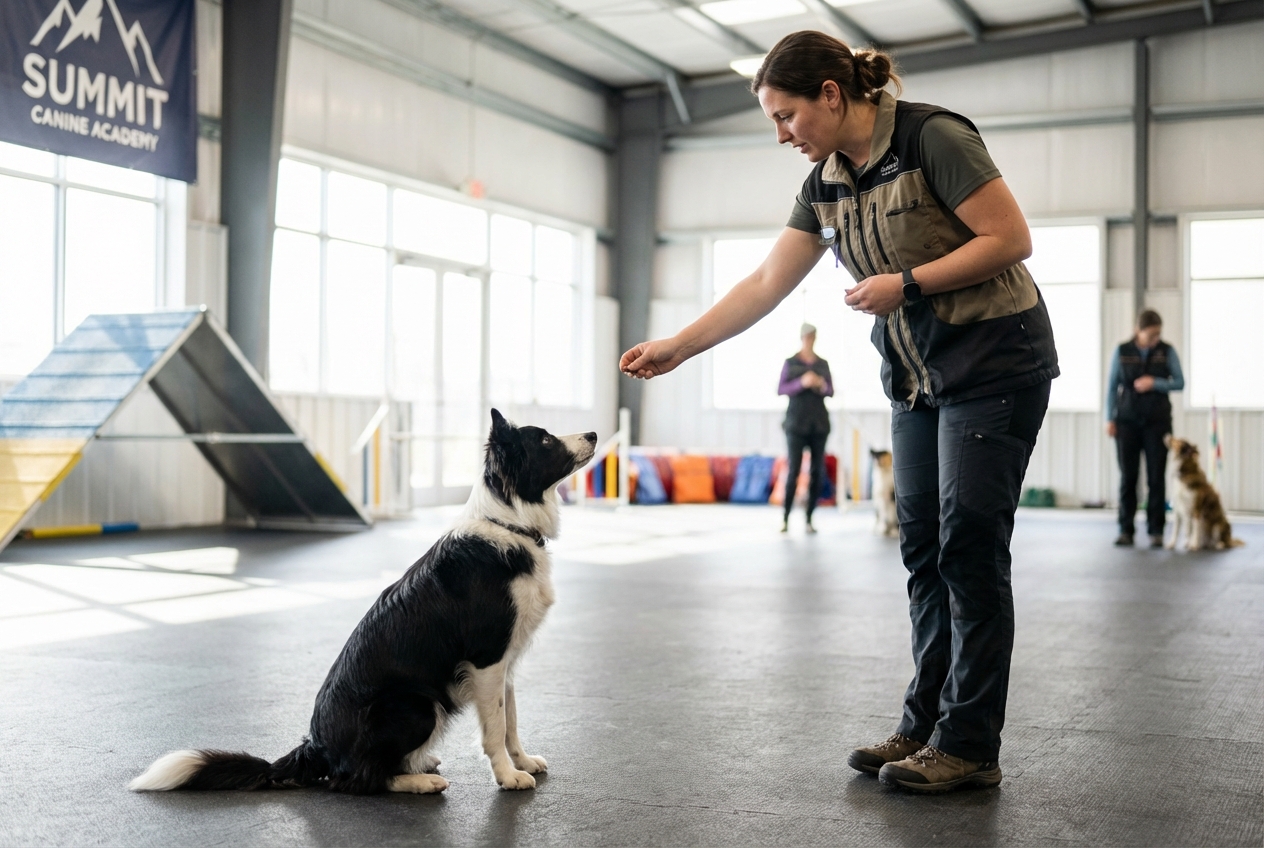
Destructive behavior when alone can come from two very different places. Treating the wrong one doesn't help either.
The owner comes home to a destroyed couch cushion. The dog ate the corner of the coffee table. The baseboards near the front door show claw marks. The neighbor says the dog was barking for most of the afternoon.
The owner's first instinct: the dog has separation anxiety. An internet search confirms it, because separation anxiety and boredom produce an almost identical set of visible behaviors. Both result in destructive chewing. Both produce vocalization. Both produce restless behavior and, sometimes, house soiling. The difference is invisible to anyone who wasn't watching the dog.
Getting the diagnosis right changes everything. A bored dog needs more mental and physical stimulation, and the solution is often straightforward and relatively quick. A dog with true separation anxiety needs a systematic desensitization protocol that takes weeks to months, and may require veterinary medication. Applying the boredom solution to a separation anxiety case produces a slightly better-occupied but still panicking dog. Applying the anxiety protocol to a bored dog wastes significant time on work that wasn't necessary.
The Diagnostic Test: Video
The fastest and most reliable way to distinguish between the two conditions is a camera. Set up a phone to record the room before you leave. Watch the first 30 minutes of footage, paying attention to the first 10.
A dog with separation anxiety begins showing distress signals immediately or within minutes of the owner departing. Pacing. Whining or howling continuously. Drooling. Focused attention on the door. Frantic scratching at exits. The dog's body is not relaxed at any point. The behaviors are driven by acute distress, not by under-stimulation.
A bored dog does something different. After the owner leaves, it typically settles. It may lie down, sleep, or wander. Then, at some point, often 30 minutes to several hours in, it starts looking for something to do. It investigates accessible objects. It may begin chewing. If it vocalizes, the vocalization is often intermittent and may be triggered by an external stimulus, a sound from outside, rather than sustained from the beginning.
"The camera doesn't lie. A dog that falls asleep within ten minutes of your leaving does not have separation anxiety. A dog that is panting and pacing at the door from minute one does. These are not the same problem."
Dr. Malena DeMartini-Price, separation anxiety specialistThe Diagnostic Criteria Side by Side
| Characteristic | Separation Anxiety | Boredom / Under-stimulation |
|---|---|---|
| Onset of distress | Within minutes of owner leaving | After settling period (30 min to hours) |
| Vocalization pattern | Continuous from departure | Intermittent, often triggered |
| Destruction location | Exits (doors, windows, baseboards) | Accessible objects, toys, furniture |
| Appetite when alone | Often won't eat even favorite treats | Eats food puzzles and treats normally |
| Behavior with sitter present | Still anxious without primary owner | Usually calm with any company |
| Body language on camera | Tense, panting, no relaxation | Relaxed body until activity begins |
| House soiling pattern | Early in absence, near exits | Later in absence, throughout space |
One additional clue: whether the dog eats when left alone. Food refusal in an otherwise food-motivated dog is a meaningful anxiety signal. A dog that will engage with a Kong or food puzzle shortly after the owner leaves is behaviorally available for enrichment. A dog that ignores a food-stuffed toy it normally loves is in a different state entirely.
Fixing Boredom
Boredom in dogs is primarily an enrichment and exercise deficit. Dogs are working animals whose behavioral needs weren't designed for a life spent primarily in a house. When physical and mental exercise needs aren't met, dogs find ways to meet them, usually in ways owners find inconvenient.
The solution has two components. Physical exercise: the dog needs enough aerobic activity to be genuinely tired, not just walked around the block. For most medium to large breeds, this means 30 to 60 minutes of sustained activity per day. A dog that spends the day destroying furniture may simply be a dog with excess energy.
Mental enrichment: the brain needs work as much as the body. Food puzzles, sniff walks (where the dog sets the pace and follows its nose), training sessions, frozen Kongs, and chews all provide cognitive engagement. A dog that has a two-hour food puzzle to work through immediately after the owner leaves has less time and motivation to chew the furniture.
The practical test: if increasing exercise and enrichment by 50% over two weeks produces a measurable reduction in the problematic behaviors, boredom was a significant contributor. If the behaviors persist at the same intensity, the problem is not enrichment.
Fixing Separation Anxiety
Separation anxiety requires systematic desensitization. The full protocol is covered in depth in our article on separation anxiety treatment, but the core principle is graduated sub-threshold exposure: the dog experiences being alone in durations so short that no anxiety response fires, and those durations are extended incrementally over time.
For separation anxiety, enrichment alone does not work. The problem is not under-stimulation. The problem is panic. A dog in a panic state will ignore a Kong it normally loves. Providing more enrichment to a separation anxiety case is like offering someone experiencing a panic attack a crossword puzzle. The state prevents engagement with the solution.
What does help: a veterinary consultation to rule out underlying medical contributors. A 2020 paper in Frontiers in Veterinary Science found that dogs with chronic pain showed significantly higher rates of separation-related behaviors than pain-free dogs. Conditions like arthritis that increase baseline stress tolerance problems can precipitate or worsen separation anxiety.
Could your dog's behavior be a health signal?
A free 60-second quiz helps identify whether your dog's alone-time behavior may have a health component worth discussing with a vet.
Take the QuizWhen Both Are Present
Some dogs have both problems simultaneously. Under-stimulation raises arousal. Elevated arousal lowers the threshold at which anxiety fires. A dog that is both under-exercised and anxious about departure may present with anxiety behaviors that are more severe than they would be in a well-exercised dog, and with boredom behaviors layered on top.
In these cases, addressing the enrichment deficit is still worthwhile, not because it treats the anxiety, but because it lowers overall arousal and makes the dog a better candidate for behavioral work. A dog whose energy needs are met is generally more responsive to desensitization training than a dog that arrives at each session already over-aroused from under-stimulation.
The priority order: rule out medical issues first. Address enrichment and exercise deficits as a baseline. If significant anxiety persists after four weeks of improved enrichment, proceed with a formal desensitization protocol. If the anxiety is severe from the start, pursue the behavioral protocol immediately while improving enrichment in parallel.
When to Involve a Vet or Behaviorist
Two situations call for professional involvement quickly. First: any dog showing anxiety behaviors severe enough that it cannot be left alone for any duration without distress. This level of separation anxiety requires a desensitization protocol that most owners cannot design accurately without professional guidance. Attempting it without guidance often produces stalling or regression.
Second: any significant behavioral change in an adult dog with no prior history of the problem. A dog that suddenly develops separation-related behaviors after years of being fine warrants a medical workup before behavioral intervention begins. The list of medical conditions that can present as behavioral changes includes thyroid disease, pain disorders, neurological conditions, and cognitive dysfunction syndrome in older dogs.
Certified applied animal behaviorists (CAAB) and veterinary behaviorists (DACVB) are the appropriate specialists for true separation anxiety. For boredom-based behaviors, a certified professional dog trainer with enrichment expertise is typically sufficient. The IAABC, ACAAB, and CCPDT directories are starting points for finding credentialed professionals.
The camera footage you collected at the start, watching when and how the behaviors begin, is often the most useful thing you can bring to a first consultation. It turns a subjective owner description into observable data, and it gives a professional what they need to make an accurate assessment rather than working from guesswork.